Velenza BOC · The Business Operations Center

Security has a SOC.
Infrastructure has a NOC.
The business has a quarterly review.

Revenue, cash, delivery and customers get a meeting every few months, put together by hand — and stale again before the next one, however often it runs.

Velenza is the BOC — the Business Operations Center for the entire business. It connects to the systems you already use, builds one picture of what is actually happening, watches it continuously, and tells you what needs you.

Built secure at the core. Your data is yours alone, separate from every other customer's. Nothing that touches an outside system happens without a decision first. How the platform is secured →

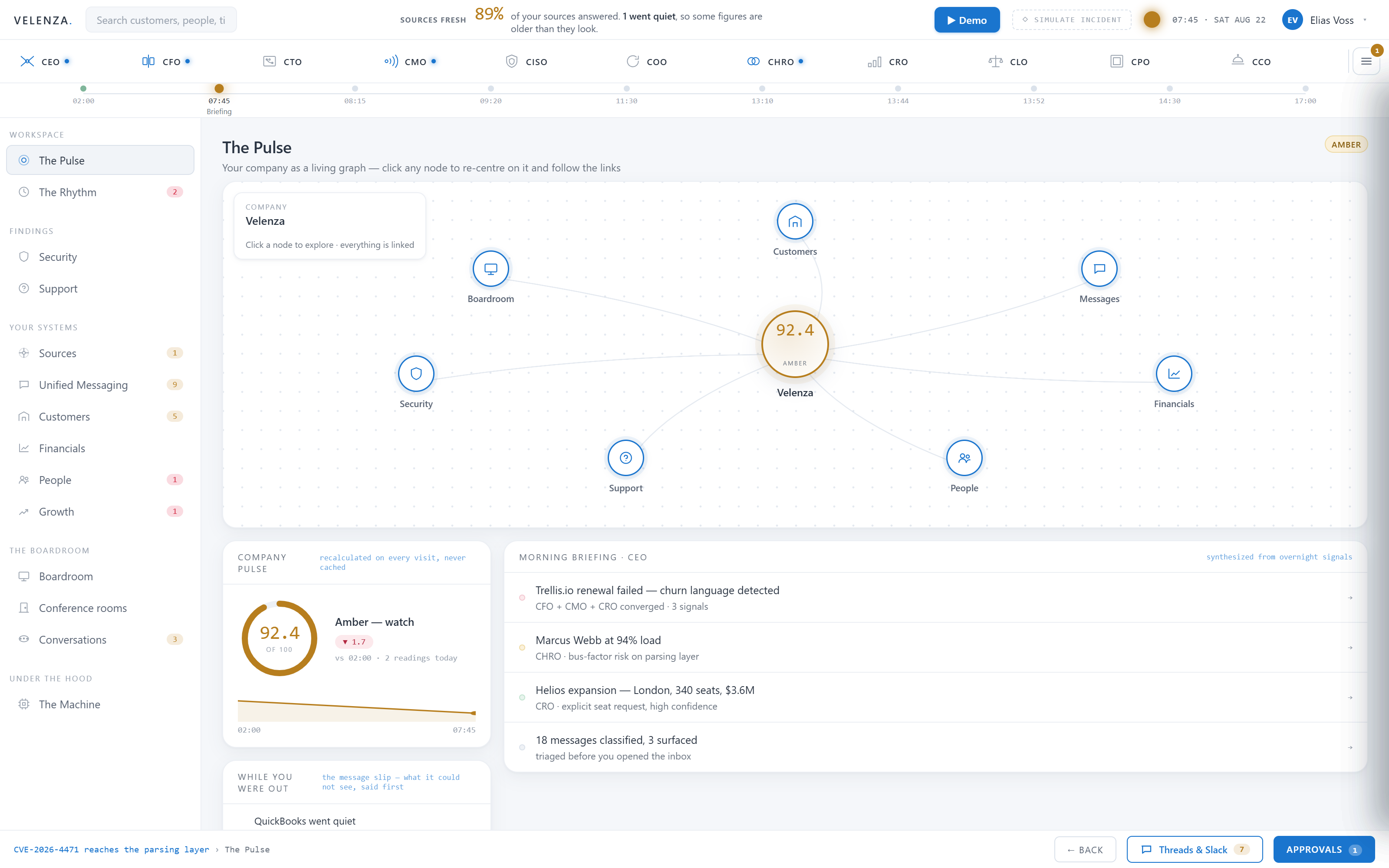
The Pulse: the company as a linked graph of customers, financials, support, people, security and the boardroom, with a morning briefing listing four cross-functional findings and the eleven advisor seats across the top
Your company as one picture, and the briefing that came out of it overnight.
Connects to what you already runWatches it around the clockShows you the evidenceAsks before it acts

The problem

No system knows what the others know.

Your accounting system knows what was invoiced. Your CRM knows what was promised. Your support desk knows what is broken. Your project tracker knows what is late.

None of them can see the other three.

So the full picture only exists when someone sits down and assembles it. That happens for a board meeting, or a quarterly review, or after something has already gone wrong. It is accurate on the day it is built and stale the week after.

Which means the things that matter most are the things no single system can see: a customer who is quietly leaving, a problem that has now happened three times, a commitment nobody is tracking against a date, a cross-functional gap two teams each believe the other owns.

Those are the ones that reach you late.

What Velenza does

One picture of your business, watched continuously.

You keep every system you have. Velenza reads them and builds a single connected view on top. What is not written down anywhere, it cannot see either — and says so, rather than filling the gap with a guess.

  1. 01ConnectsTo the systems you already run.
  2. 02LinksThe same customer, invoice or person across all of them.
  3. 03WatchesContinuously, not on a reporting cycle.
  4. 04Tells youWhat needs a decision, with the evidence and an owner.
  5. 05ActsOnce you have said yes.

What it catches

The things that only show up when you look across systems.

Here is a real example of the kind of problem Velenza is built to find.

Two customers report problems on the same day. One says a nightly data sync is dropping records. The other says an import is failing silently.

In a support queue these are two tickets. Different customers, different symptoms, two engineers, two places in the backlog.

They are the same underlying fault. One fix closes both, and both accounts have real revenue behind them. That changes what should happen next.

Velenza also knows something the support queue does not: one engineer has been doing most of the work on that part of the system, and is already at capacity. So the fix, the repeat problem, and the person who would have to do it are one situation, not three.

Seeing that needs the support desk, the code, the project tracker, the org chart and the customer records at the same time. No single tool has all five.

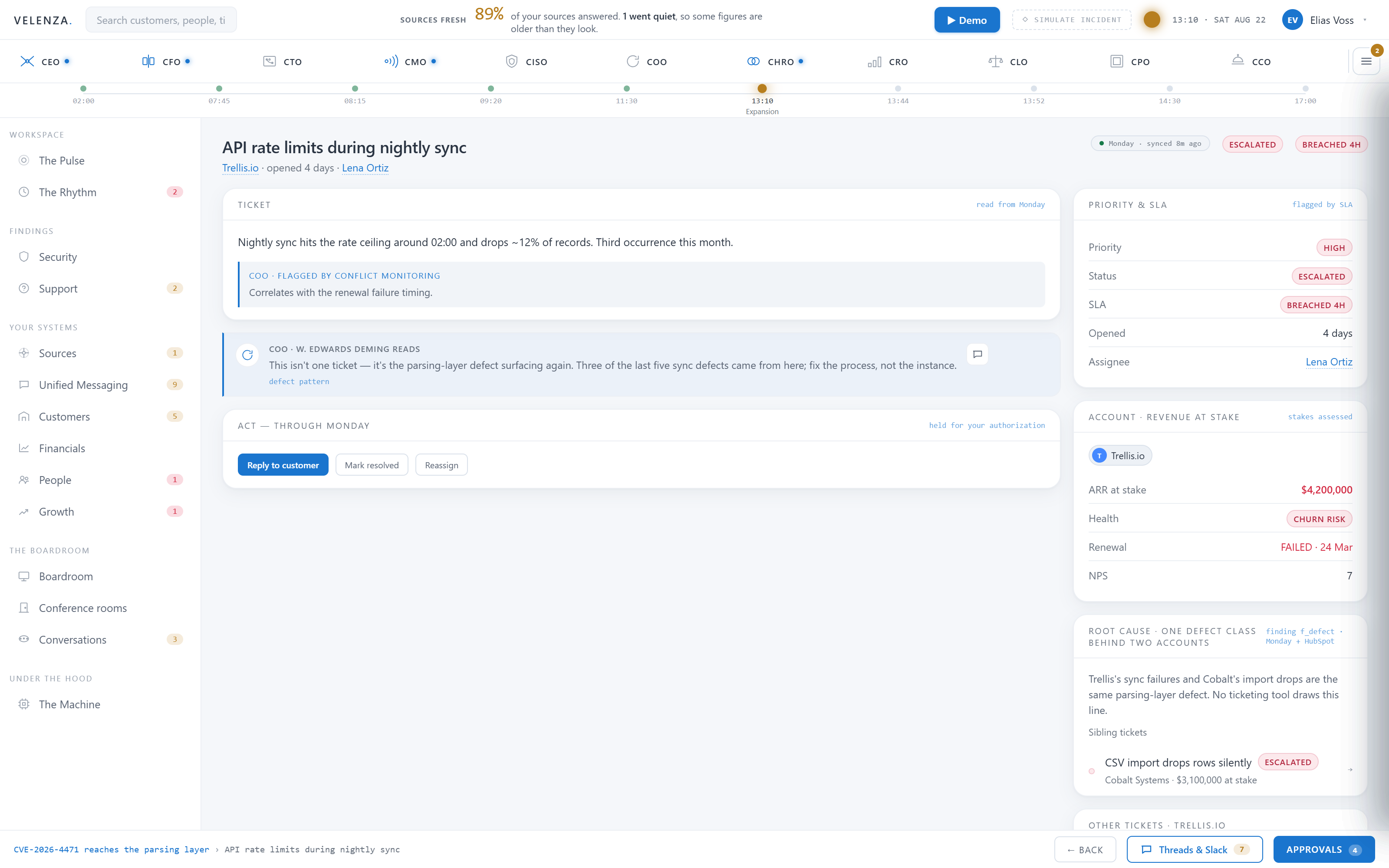
An escalated support ticket about nightly sync rate limits, with a root-cause panel showing that another customer's silent import failure is the same underlying fault, and the revenue at stake on both accounts
Two customers, two tickets, one cause, and the revenue behind both.
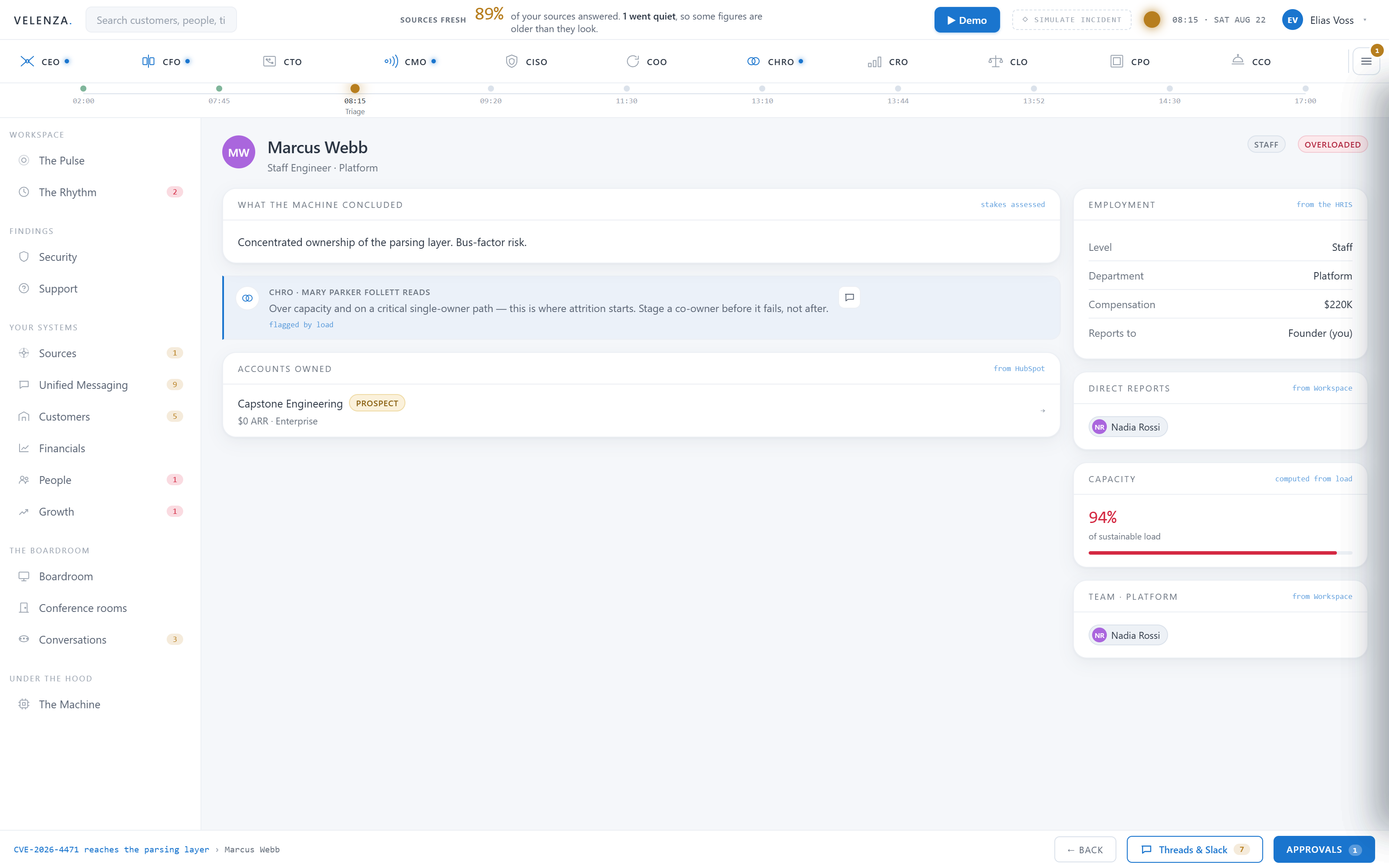
An engineer profile showing ninety-four per cent of sustainable load, one direct report, the accounts he owns, and the machine's conclusion that concentrated ownership of the parsing layer is a bus-factor risk
The same part of the system, from the org chart: one person, already at capacity.

You always see why

Every conclusion comes with the records behind it.

A failed payment, an escalated ticket and an email from a customer are three separate events in three separate systems. On their own, none of them is worth interrupting anyone for.

Velenza holds them against the same account, so what they add up to is visible as one thing — and nothing reaches you until they do.

And when it tells you something, it shows you what it read: the invoice, the ticket, the message. You are never asked to trust the conclusion on its own.

How evidence works →
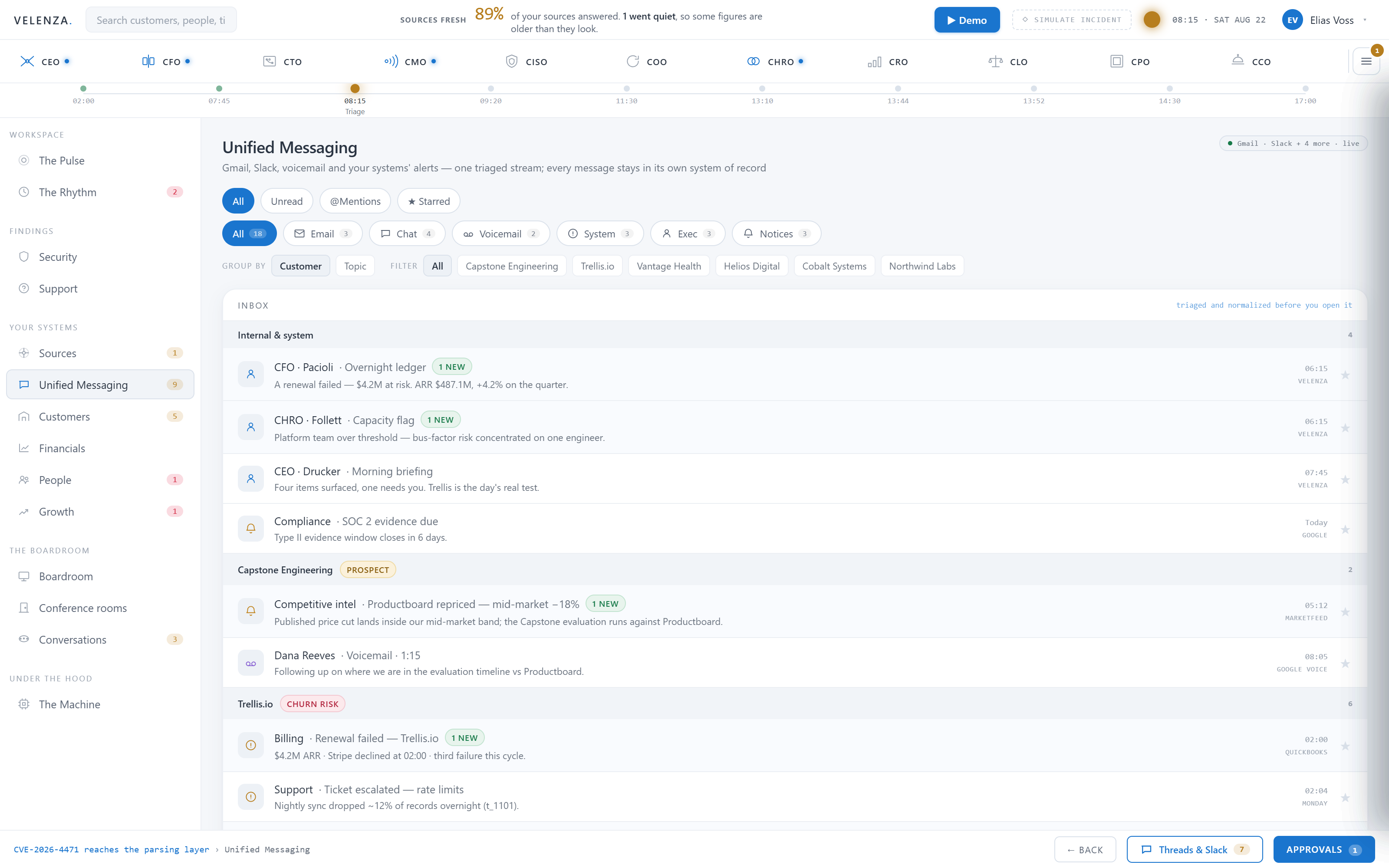
One inbox grouped by customer: under one account, a failed renewal from billing, an escalated support ticket, a customer email, a voicemail and an internal chat thread
The signals arrive separately, and get grouped by the account they belong to.
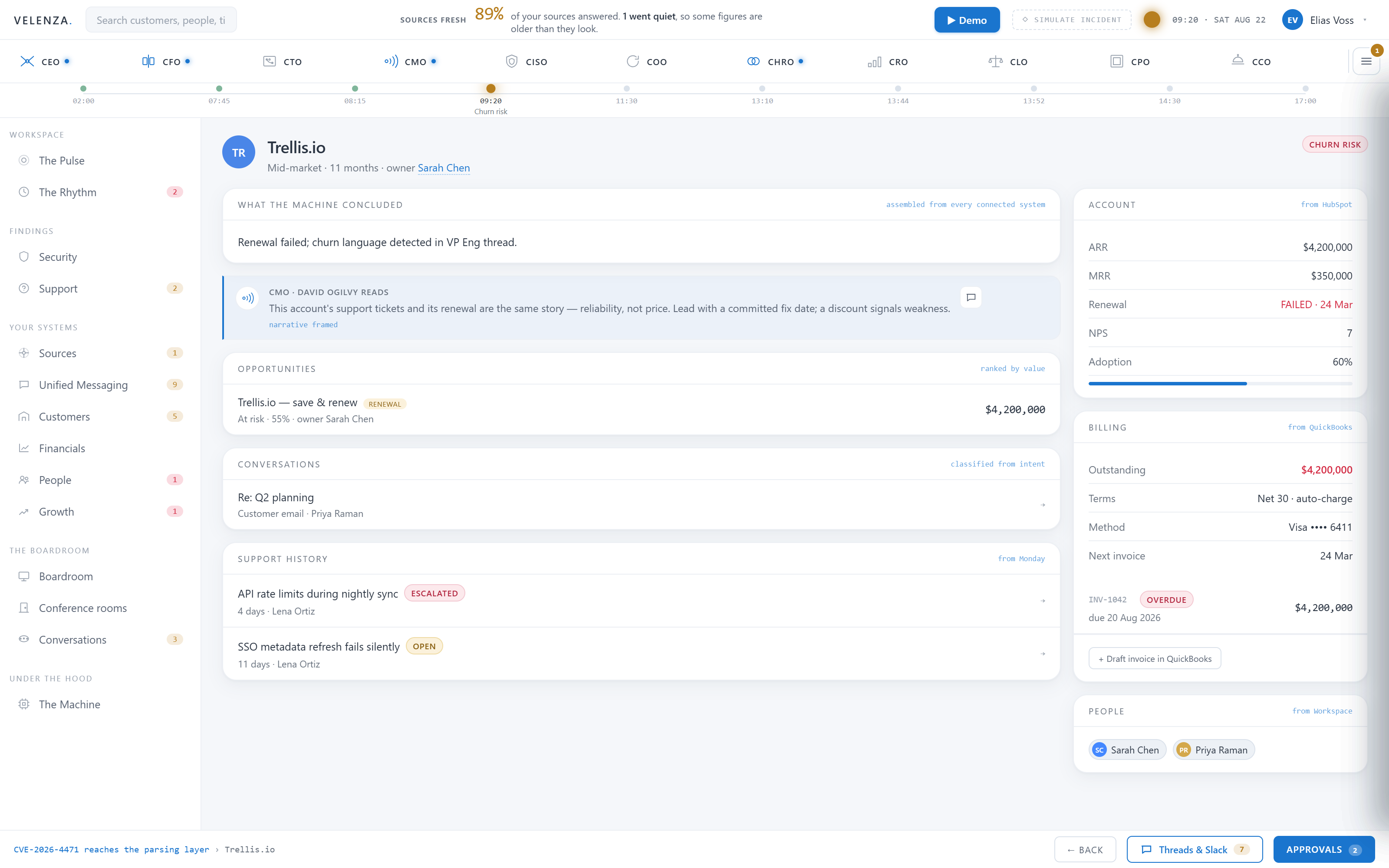
A customer account showing the conclusion the system drew, one advisor's read on it, and the billing record, support history and conversations it came from
Then the conclusion, with everything it was drawn from sitting beside it.

Nothing gets replaced

Your systems keep doing their jobs.

Velenza is not an accounting system, a CRM or a help desk, and it is not trying to become one. There is nothing to migrate.

Your accounting system stays your books. Velenza reads it, and connects what it finds there to everything else: the invoice to the account, the account to the contract, the contract to the work.

  • Reads the systems you already run
  • Links the same thing across all of them
  • Your data stays yours, and you can take it out
Where your data lives →
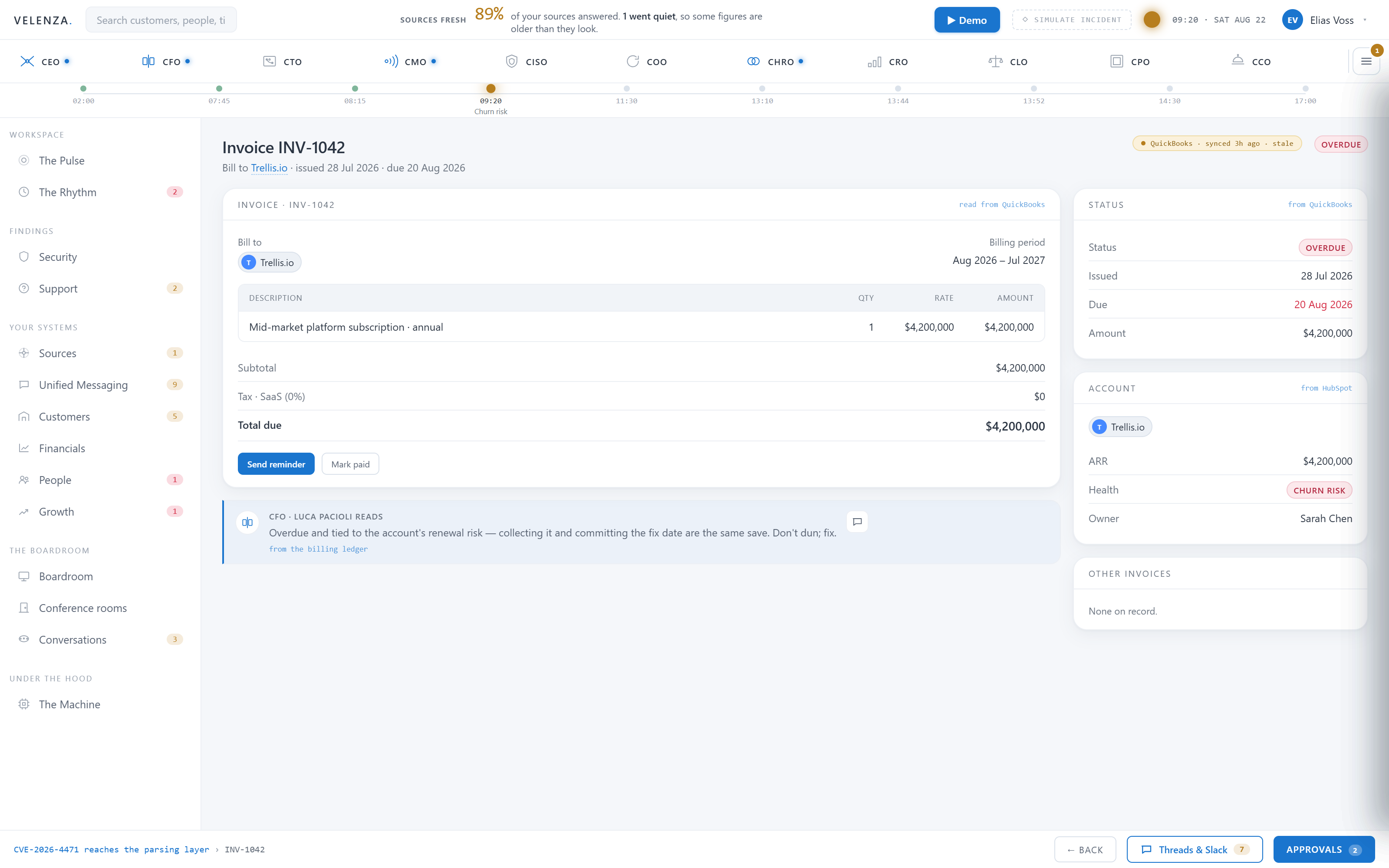
An overdue invoice shown with the account it belongs to, its revenue, its health status, its owner, and an advisor's read on what to do about it
One invoice, with the account, the owner and the risk attached to it.

You stay in control

Nothing with consequences happens without your say-so.

Watching, connecting and drafting happen on their own. Anything that reaches outside the company stops and waits.

Before any action that could have a real effect, it has to clear what you've allowed, given who is asking and what the action would do. If it doesn't clearly clear, it doesn't happen on its own — that's where you come in.

When it does need you, you see the actual thing before it goes: the real email, the real invoice. Not a summary of it.

And if something has to be undone, Velenza does not pretend it can reach into your accounting system and reverse a transaction. Nobody can do that. Instead, anything that might need undoing has a real way to undo it, decided and confirmed before it is ever allowed to run. If the outcome of an outside call is genuinely unknown, the system says so and waits for a person, rather than guessing.

How this works in detail →
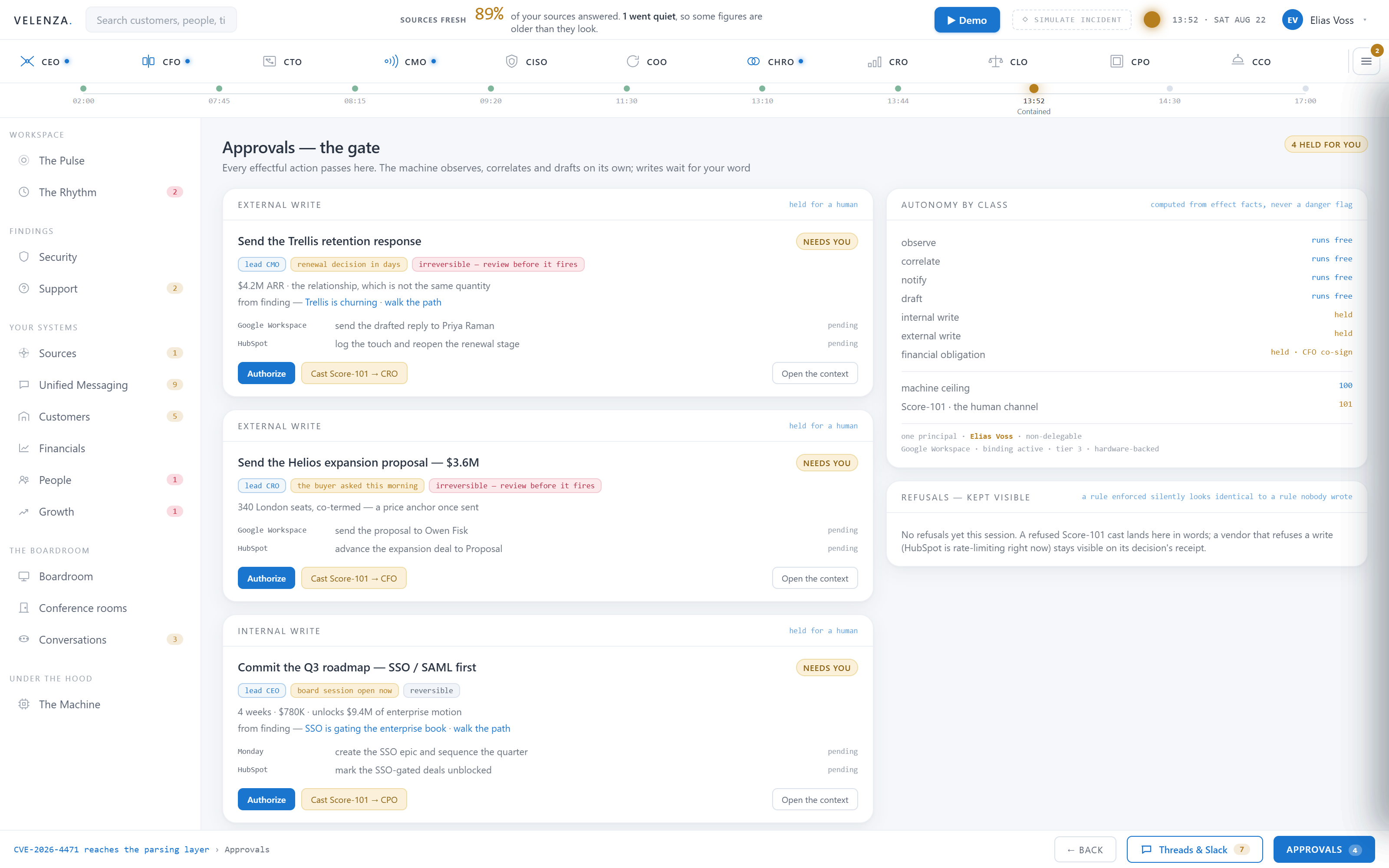
Four prepared actions waiting for authorization, each showing what it would do in which system, an Authorize control that releases it, and a Score-101 control that hands the decision to a different advisor
Prepared and waiting. Review opens the real item before anything is sent.

Eleven advisors

A different view for every seat at the table.

Most software gives everyone the same screen and a set of filters. A CFO and a head of people then look at the same dashboard and hide the rows they do not need.

Velenza is built the other way. Each executive function gets its own view, its own standing questions and its own findings, because they are different jobs.

Each one also has a point of view. The finance seat reads your books the way Luca Pacioli would, who wrote down double-entry bookkeeping in 1494. The product seat ranks your roadmap the way Henry Dreyfuss ranked a design, and will tell you what to cut. They advise, they show their reasoning, and they write everything down.

Meet all eleven →
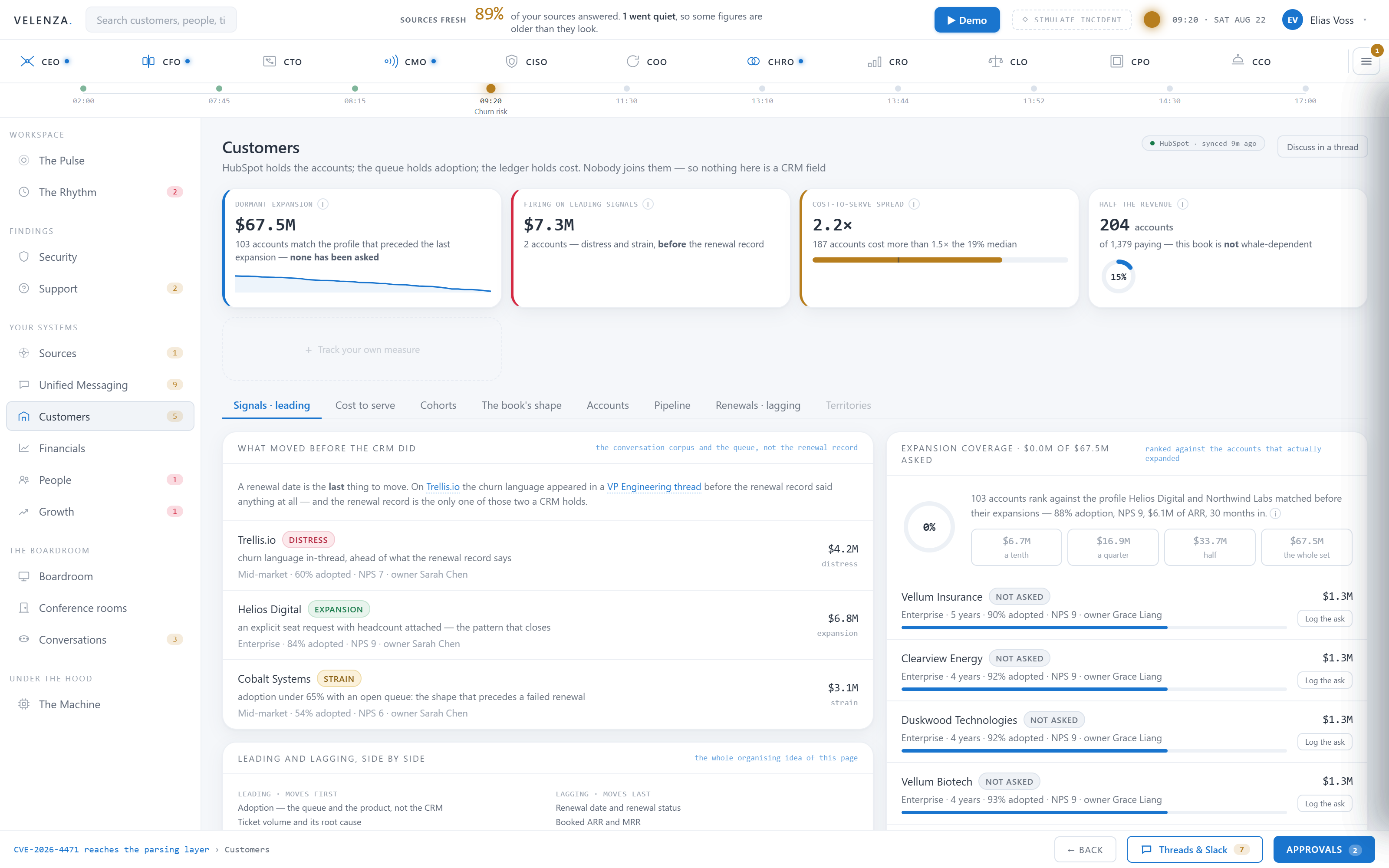
The customer book organised by what moves first: sixty-seven million in dormant expansion across accounts matching the profile that preceded the last expansion, none of them asked; two accounts showing distress before the renewal record does; and a panel separating the leading signals, adoption and ticket volume, from the lagging ones, renewal date and booked revenue
Down the left, the eleven advisors, each showing what it is working on right now.

Getting started

No data project first.

Velenza reads your systems directly. There is no warehouse to build, no data model to design and no internal project to fund before anything useful happens.

Connecting a system is quick. That part is the platform's job and does not need your engineers.

The one thing that needs you is agreeing what is what. Different systems spell the same customer differently. Velenza works out most of it and shows you the handful it cannot be sure about. Somebody who knows your business confirms that list once. It takes hours, not months.

Your data team is not in the way, and is not being worked around. Where you already have an agreed definition of a number, that definition wins.

See how this compares to what you already own

SEE IT ON YOUR OPERATION

Bring us a question you answer by hand.

Most executives have one: a question that takes a person half a day and three systems to answer, every week. Tell us yours and the systems it lives in, and we will show you what it looks like when it answers itself.

Request a walkthrough

Email [email protected] with your company, your role, and the question. We reply personally.